
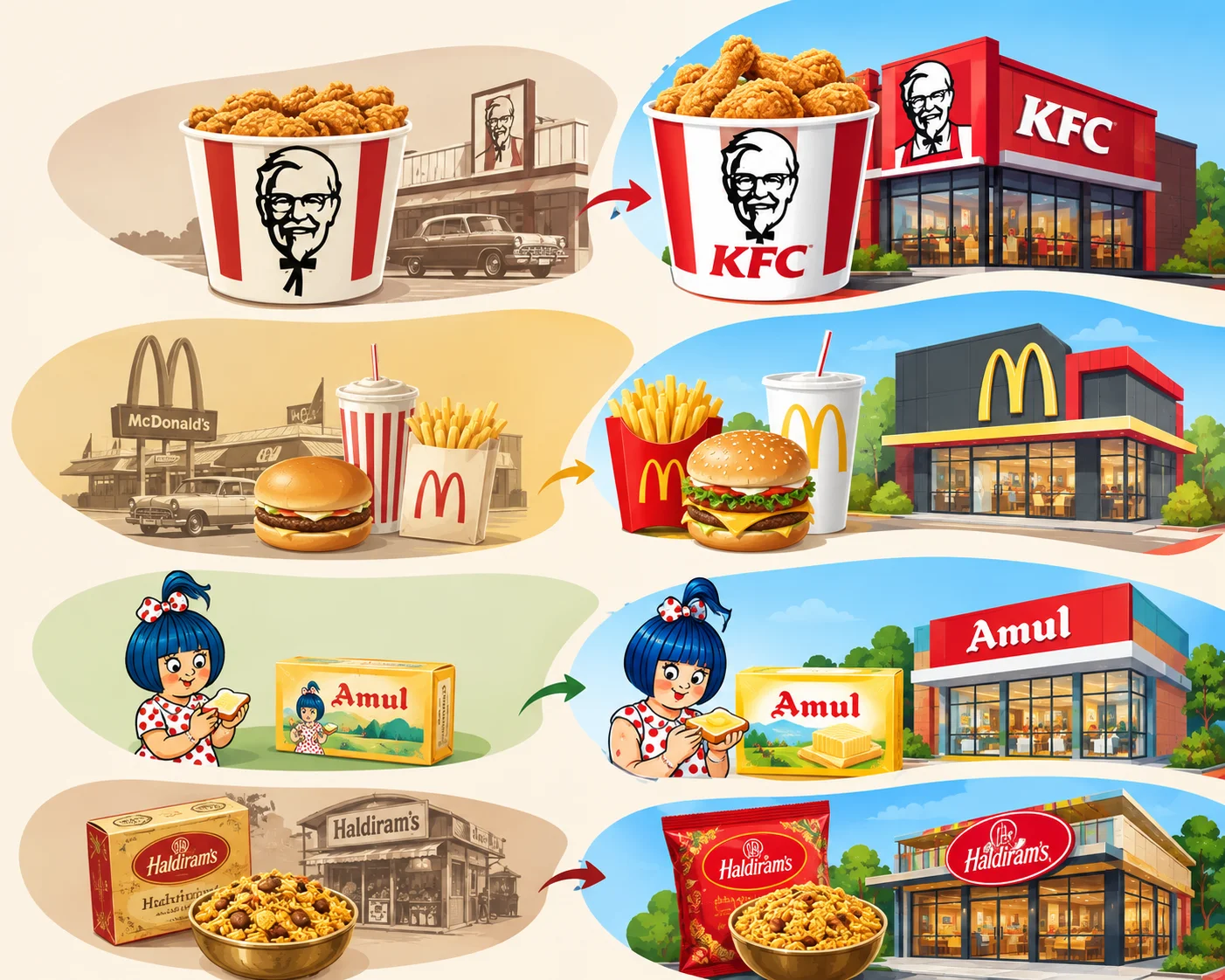
The KFC you recognise today does not look exactly like the KFC your parents knew. McDonald’s packaging, restaurants and advertising have changed dramatically over the decades. Even homegrown names such as Amul and Haldiram’s have found ways to remain familiar while communicating with new generations.
That is the power of food brand evolution.
Food brands operate in an unusually emotional category. A logo can remind someone of childhood. A packet colour can trigger recognition from across a supermarket aisle. A restaurant sign can bring back memories before a customer even sees the menu. This makes evolution necessary, but also risky.
The goal is not to chase every design trend. It is to understand what consumers already love about the brand, preserve those valuable associations and evolve everything around them.
For growing food, restaurant and FMCG businesses, the biggest brands offer an important lesson: relevance changes, but recognition should remain.
Want Your Brand to Evolve Without Losing What Makes It Recognisable?
At Bestow, we help businesses build identities and strategies designed for long-term relevance. If your food or FMCG brand, get in touch with Bestow and build an evolution your customers will recognise and remember.
Get in touch with the usWhat Does Food Brand Evolution Really Mean?
Brand evolution is the deliberate process of updating how a brand looks, sounds, communicates or operates while preserving its fundamental identity.
That distinction matters.
A complete food brand rebranding may involve significant changes to positioning, naming, identity or audience. Evolution is generally more gradual. It might mean simplifying a logo, modernising packaging design, refreshing restaurant interiors, developing a more contemporary tone of voice or adapting campaigns for digital platforms.
A strong brand identity therefore needs both consistency and flexibility.
Think of it as renovating a well-loved restaurant rather than demolishing it. Customers should notice that something feels fresher, but they should never wonder whether they have walked into the wrong place.
KFC: Evolve the Brand, Keep the Colonel
Few examples explain the KFC branding strategy better than Colonel Sanders.
KFC’s visual identity has changed repeatedly, but the Colonel has remained central. KFC itself notes that its logo has adapted over the years while Sanders’ face has stayed at the forefront. Its famous bucket, introduced in 1957, has similarly become a distinctive brand asset.
That approach continues today. In June 2026, KFC announced refreshed global branding alongside updated restaurants and menu innovation. Yet rather than abandoning its history, the company said its refreshed identity would remain grounded in the Colonel, the bucket and its “Finger Lickin’ Good” heritage.
Food Branding Lesson: Identify What You Cannot Afford to Lose
Before a logo redesign, ask:
What would customers still need to see to instantly recognise us?
It could be a colour, symbol, mascot, typography style, packaging structure or even a phrase. Once those distinctive assets are identified, the rest of the visual identity has greater room to evolve.
A thoughtful brand strategy distinguishes between assets that carry brand equity and elements that have simply become outdated.
McDonald’s: Modernise the Experience, Not Just the Logo
McDonald’s branding demonstrates that evolution extends far beyond a logo.
Its Golden Arches originated from architectural features of early restaurants before evolving into the globally recognisable symbol customers know today. Its packaging has evolved too, from functional innovations such as the red fry box to modern global designs using bold, playful graphics.
Yet McDonald’s continues to lean into familiar menu items, memories and cultural associations. Its own retrospective of burger advertising shows decades of changing creative styles surrounding recognisable products and brand assets.
This combination of newness and familiarity is powerful nostalgia marketing.
Bestow has previously explored why nostalgia marketing can boost engagement. For food brands especially, nostalgia works because the product often becomes attached to occasions, people and phases of life.
Food Branding Lesson: Modernise Around Familiarity
Customers do not necessarily want their favourite brands frozen in time. They want them to remain recognisable while fitting naturally into contemporary culture.
That means evolving digital experiences, packaging, campaigns and physical spaces without casually discarding accumulated brand equity.
It is similar to the broader marketing lesson behind logo and identity trends: modernisation works best when distinctive brand assets remain stronger than the trend itself.
Amul: Consistency Can Be an Evolution Strategy Too
Not every successful evolution requires dramatic visual change.
Amul offers one of India’s strongest examples of brand consistency. The Amul topical campaign began in 1966, and the company has explicitly credited consistency in long-term communication with firmly establishing its brand identity in consumers’ minds.
The format remains recognisable while the subjects constantly change.
That is evolution through context rather than reinvention.
Food Branding Lesson: Create a Flexible Brand System
Successful Indian food brand marketing needs recognisable structures that can respond to changing conversations.
The mascot stays. The wit stays. The topical subject changes.
For modern brands, the equivalent could be a recognisable social-media template, illustration language, photography treatment, tone or packaging architecture.
Building a flexible brand identity system across AI, social and web platforms can help businesses maintain that recognition even as channels multiply.
Haldiram’s: Heritage Does Not Have to Look Old
Haldiram’s demonstrates another challenge in FMCG branding: how do you modernise a traditional brand without making it feel less authentic?
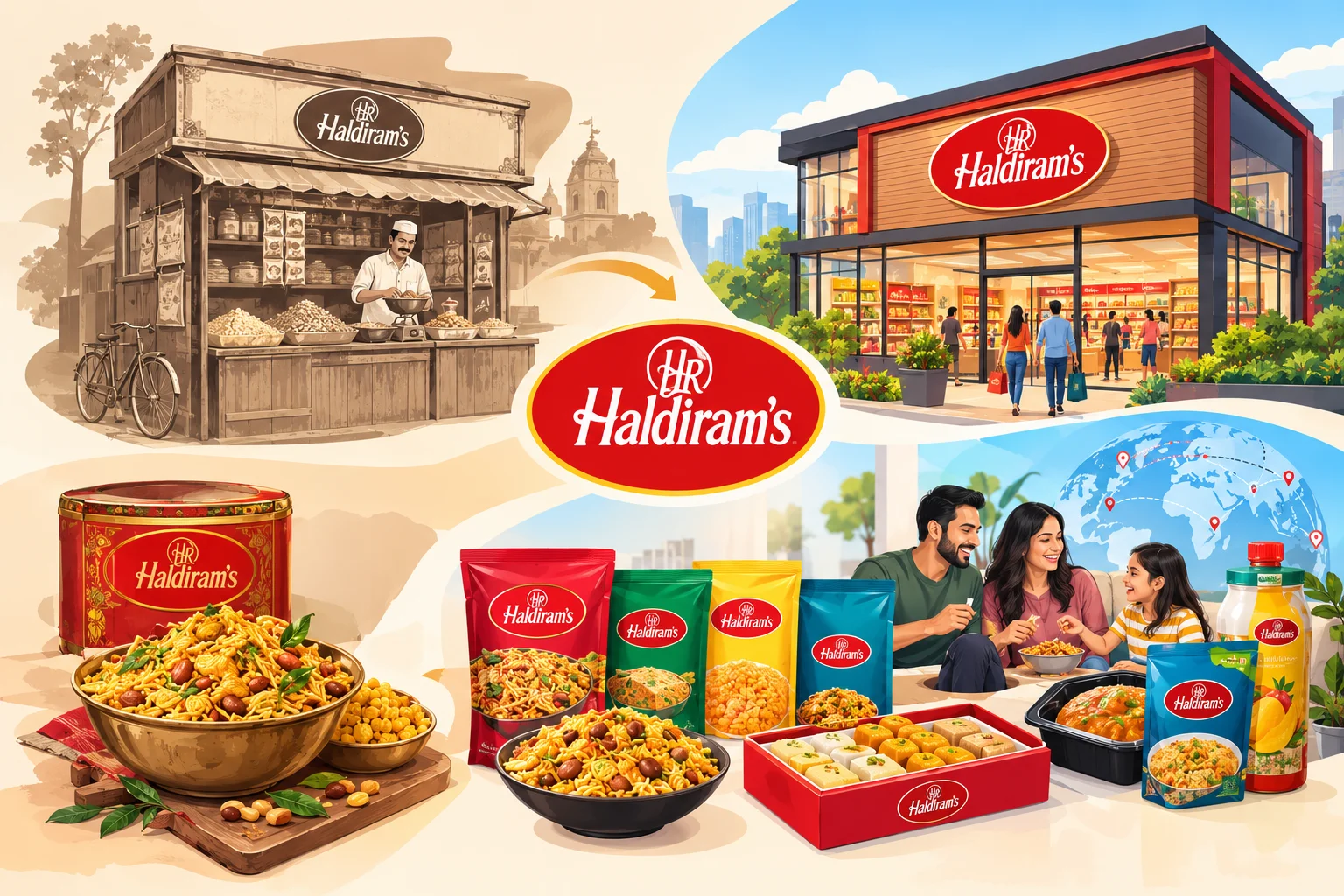
The company describes its journey from a small Bikaner namkeen shop to an international FMCG portfolio spanning sweets, snacks, ready-to-eat products, frozen foods, bakery and beverages. Its current brand message emphasises that formats can evolve while the promise of authentic flavour and dependable quality remains.
Earlier identity work around Haldiram’s also addressed the challenge of reaching more urban and internationally minded families while retaining its traditional associations.
Food Branding Lesson: Evolve Consumer Perception Without Erasing Heritage
A traditional brand does not need to become minimalist simply because minimalism is fashionable.
Instead, repositioning should begin with insight. What does the existing audience value? What prevents a new audience from considering the brand? Which signals feel dated, and which communicate authenticity?
This is where consumer insights can transform brand strategy by replacing subjective design decisions with evidence about perception and behaviour.
Packaging Is Often the Real Brand Experience
For FMCG businesses, customers may interact with packaging more frequently than with the company’s website, advertisements or social channels.
Packaging therefore performs several jobs simultaneously. It creates shelf recognition, communicates quality, differentiates variants and influences expectations before the product is opened.
McDonald’s demonstrates the same principle in QSR: packaging can become part of the experience rather than merely a container.
For restaurant branding and packaged-food businesses alike, every touchpoint should feel like it belongs to the same world.
The Biggest Food Branding Lessons Businesses Should Remember
Across KFC, McDonald’s, Amul and Haldiram’s, several food branding lessons repeatedly emerge:
Protect distinctive assets. Do not discard recognition simply to appear modern.
Evolve for a reason. Changes should solve a consumer, competitive or business problem.
Keep storytelling consistent. Strong brands evolve their expression without constantly changing their personality.
Treat packaging as branding. The pack is often your most visible physical media.
Use nostalgia selectively. Heritage can create emotional connection without making a brand feel outdated.
Build systems, not isolated designs. Logo, typography, packaging, stores, digital channels and communication should reinforce one another.
Most importantly, evolution should strengthen the story customers already believe about the brand. Effective brand storytelling built around emotion can make that continuity visible even when the brand itself is changing.
From Familiar to Future-Ready: The Real Goal of Brand Evolution
The strongest brands are rarely those that never change. They are the ones that know what to change and what to protect.
KFC protects the Colonel. McDonald’s protects the Golden Arches and familiar products. Amul protects its distinctive communication style. Haldiram’s protects the promise of authentic Indian flavour.
That is what effective food brand evolution looks like.
For emerging food businesses, the objective should not be to imitate these brands visually. It should be to adopt their discipline: understand your strongest associations, build a coherent identity, listen to changing consumers and evolve without sacrificing recognition.
Bestow helps businesses develop strategy, identity and creative systems that can grow without losing what made customers notice them in the first place.
Connect with usFAQs
Consumer tastes, channels and cultural expectations change. Brand evolution helps established businesses remain contemporary while protecting familiar assets that already carry recognition and trust.
Brand evolution gradually updates an existing identity while retaining its core equity. Rebranding can involve more fundamental changes to positioning, visual identity, messaging or even the audience a business wants to reach.
Indian brands can learn to protect distinctive assets, create consistent experiences across touchpoints and modernise strategically rather than following every design trend.
There is no fixed timeline. A refresh makes sense when the identity no longer reflects the audience, positioning, competitive environment or channels through which customers experience the brand.
It can if too many distinctive elements disappear at once. Strong redesigns usually retain recognisable colours, shapes, symbols or other visual cues while simplifying or modernising their execution.
Packaging influences shelf recognition, quality perception and purchase decisions while communicating the brand’s personality. For FMCG brands, it is often one of the most frequent customer touchpoints.
They define core assets and principles that remain stable while allowing flexible elements such as campaigns, layouts, imagery and messaging to change with audiences and platforms.
Consistency, thoughtful design, clear positioning, credible storytelling, quality packaging and reliable product experiences collectively shape a premium and trustworthy brand identity.
Categories
Recent Blogs
Send us a message
We'd love to hear from you
Let's build a plateform that works for you busines and the advertisers who trust it.
Talk to Our Expert